
That guy in the middle seems too happy. Somebody is going to get hurt.
The middle of the circle is where people get hurt. Do not go in until you've mastered the outer circle and the Hand on Shoulder Forward Back Step. More accidents happen the closer you get to the middle. They start breakdancing to Hora moves, arms start flailing, one guy does a wave and somebody gets hurt. Jews move around and body control is lost.
Go to a Hassidic dance with a Rebbe, if you're not ready and don't have training in Hassidic enjoyment, you will get hurt. You have to fight your way into that middle circle, where you get met by four hundred pound bodyguards throwing you out. Choolante strength is a thing. They guard the Rebbe from the heretics who diet on Shabbis. People go wild in the middle, so be safe. When Jewish people ‘get down’ it gets dangerous. If you make it to the middle, here are some important dance moves you must know. The Arm Raise Part of the traditional Hora dance circle, this is where you lift your arms. Forearms must be facing in, supinated. Forearms facing out is not what Jews do. This isn't a Jewish revival convention. Jews always dance in supinated form. Even when dancing, your expression should be one of complaint and questioning. We don't go into the middle of the circle to give high fives. This is not a free-for-all. This is connection back to the early 1700s in the Ukraine. Also known as the Two Hand Lift, this is a favorite amongst Hassidic dancers. The only exception is if you're from Yemen. Then you can pronate. Arm Raise Hand Open Close This can be done by one guy. This just looks cool. This is where you take that hand facing in, squeeze and unclench. If you look up, it looks like you're complaining to Gd. You will want to work on the complaint genre of dance. The Chest Bounce Somebody had a friend who likes heavy metal and now very small people get injured. Huddle Jump Done by people who never played organized football, you put your arms on the shoulders of the people near you and then jump around in a circle. Just jump. That's the dance. You can do this with as many partners as you want. One partner may be too intimate for the newcomer to the middle circle. This is as close to athletics any devout Jew should get. The Solo Jump Around Similar to the Huddle Jump, this is where you let go of the other people and jump by yourself. It's not a very warm dance and makes you feel alone, without community. Unlike the Huddle Jump, where you have the support of your fellow. This dance goes very well in combination with the Israeli Side to Side Jump. Another variation of the Solo Jump, the Israeli Side to Side keeps you in one spot; no aroundness in the Israeli Jump. By combining them, you can go side to side and around in solo form. This dance is almost as uncomfortable as being forced to dance in front of the bride and groom. Waving your arms in this makes you look like you know what you're doing. It also opens up your dancing radius, by forcing away other people who don't want to get hit. Arm Interlocked Twirl Around Similar to the British folk country dance, this is very fun until somebody else steals the person you were twirling around with. Now you're alone. They interlock arms and take your place, sneaking in from the other side. Kind of like musical chairs, I am found wandering around in a circle by myself, with nowhere to go. And many times, I am even asked to leave the circle. The Hand-in-Hand Spin Interlock arms with somebody else and go in a circle for as long as you can, until you let go and the other person flies or falls, or until one of you pukes. The Airplane Dangerous. Some call this the helicopter because that is also dangerous. And some call it the propeller, because that is the most dangerous part of the helicopter. Either way, you want feet flying towards the outside of the circle. The objective of this dance is to injure other people. Make sure to initiate this dance when the middle circle is crowded. The Face to Face Hands on Shoulders This is for two people who can't move. You brace yourself on the other person and try not to fall. The One Hand Hold Side to Side Kick A classic. With the longest name of any dance, this dance's name describes what it is. You kick from side to side, one leg at a time, alternating. To funk it up a little, switch the hands too. This is almost as complicated as rubbing your tummy, while tapping your head. Again, stretch before this one. And watch out when getting close to it. If you're a spectator, the lack of kick control and athletic ability of the kickers makes this dance almost as dangerous as the helicopter. The Rebbe Approach This is more of a still motion where other people force you in different directions. Known to be dangerous in America on Black Friday, the mob does the dance for you. That is how you become a Chasid. Chasidim beat you on your way into the middle circle. It's part of the initiation process. That is their hazing process for joining their sect. The NaNachs make you jump while saying ‘NaNachNachimNachmanMUman’ 20 times, real fast. The other sects hurt you real bad. Final Note of Safety Do not join any middle circle dance if you have any sort of back problem or arthritis. No older Jewish man should be dancing in the middle. The outside of the circle is for you. The Stand and Clap is the dance you should be doing. Always be careful. When Jewish people ‘get down’ it gets dangerous. Watch out for flailing arms. That is the move, arms go up in the air and somebody gets hurt. I also suggest you start on strict weight training and powerlifting program before approaching any rebbe. Next time we will talk about the middle circle dancing in front of the bride and groom, where you embarrass yourself in the Jewish cypher. Tags:
The Recommended Content Widget will appear here on the published site.

I can't wait to hit Chevron and the graves of our forefathers. Such good times. (Photo: IDF Spokesperson Judah Brigade)
My first time I went out in Israel it was for a drink. Me and a bunch of guys from the Yeshiva went out for a Lchaim. It was a Thursday night and we went for a beer. In Israel, Thursday nights are like Saturday nights, and I like that. It's better to bring a hangover to shul than work.
That first night out might have been a spiritual experience. I don't remember what happened. Though, it was Israel, so it was a holy night out drinking at the bars. I was new to the Yeshiva experience and I was good at it. Once the High Holidays came, the spiritual experience of partying in Israel changed. Thursday night after Rosh Hashana, my friend Yanky said, 'Let's go out tonight.' So, I went. You don't argue with Yanky, unless if you want a heated debate. He was a second year guy in the Yeshiva and he already learned how to scream at people when learning Gemara. Yanky was masterful at yelling at his Chavrusa, learning partner, which meant he knew what he was talking about. The more you reproach your Chavrusa, the better learner you are. Being a Chavrusa to Yanky was an honor that very few had. He was the perfect Chavrusa for learning Gemara Baba Kama. No other Chavrusa had the ability to make you feel like you were being scolded and abused while learning the laws of damages. We went up north. I thought we were going out. I didn't realize that meant a two hour drive. Going up north in Israel is a spiritual experience, as roads are windy and not lit, and you're dependent on Gd to not get hit by the falling rock. There was a sign that read 'Falling Rock,' which kind of scared me, as that meant rocks were falling right now. Adding to the spirituality of Israel, I said my first prayer at that moment. Not fully understanding the excitement of going up north, we ended up at the Rambam's grave-site, and Yanky started to scare me. I thought we were going out to party, and we were now at the graves of Tzadikim (righteous people). I had no idea what to think. I thought I might've joined a Yeshiva full of hedonists, who have some kind of grave-site rituals. Maybe it was part of the Yeshiva hazing process, where they tell you about righteous rabbis and then leave you in the graveyard to get eaten by ghosts. I was scared. And then the good times started to role. After the Rambam's Kever, we hit the graves of a few more rabbi's and even a prophet are two. We prayed. We had rugalach. We drank schnapps. And since then, going out has never been the same. The coolest thing of all. We prayed. We drank and prayed. And I got back to Yeshiva alive. And I was scared to talk to Yanky for a month and a half after that. Since that night out with Yanky, my life has changed. Now I know what going out means in the Frum world. Follow Up Notes It's a new form of partying I've taken on. That's how us religious people do it. What am I doing later tonight? I'm going up north and hitting some Kevers. It's just good times. The rabbis who have passed, Z"L, are what makes for the Thursday night experience. Last time we hit the Kever of the Rambam. Then we popped over to Rabbi Shimon Bar Yochai. We even headed to Yonatan Ben Uziel. On the way back we stopped off at Rabbi Meir Bal HaNes. We got back to Jerusalem right when the bars were closing. Amazing. And we got free rugalach. Rugalach is the backbone of all Jewish events in Israel. And when its free, it's a real Simcha. Now I get excited to see dead people and take down a few. And I understand why Yahrzeit candles come in shot glasses. Can't wait to hit the Ari's Kever this Thursday night. It's going to be dope. Hit the grave and then go for a dunk in the cold bath. The Frum people call it a Mikvah. I used to do baseball tours. I now see there are Gedolim (important rabbis) that are buried all over the world. I'm going to definitely do a Kever tour of Europe. I think I'll enjoy seeing the graves more than the anti-Semites. How do I know who the more important rebbes are? I judge by the size of the hole by their grave. The bigger the rebbe the bigger the pit at his Kever. This allows for more notes to be tossed in. Though, older rabbis and righteous ancestors don't have note pits. In the 1200s, people didn't walk around with pens and Post-its. There are also more candles at holy Kevers of ancient rabbis. Tea lights also represent the holiness of our sages. The more tea lights the holier the sage. I'm still trying to figure out who the better rabbis are. It's very confusing. The Rambam's Kever doesn't have a tea light focus. Due to that, the Rambam's Kever is not a top party destination. Tags:
The Recommended Content Widget will appear here on the published site.
Chasidim Follow the Rebbe8/31/2022 
Last week, we talked about the beautiful Tish experience, where the Chasidim stare at the rebbe while he eats. A beautiful tradition that kills the rebbe's dinner arrangements with his family. I argued with the Chasidim at the Tish and told them to 'let the rebbe eat.' Instead, they were staring at him and taking his food. Truth be told, I got involved in taking the food as well. Once I realized I didn't have to pay for it, I scarfed down a lot of potato kugel.
As I followed my Chassidic friends again this week, I learned that the rebbe is constantly followed; not just when he's eating. They follow him to work, when he's shopping, on holidays. There are always tons of Chasidim around the rebbe. And for good reason. Here is more of what I learned of the beautiful tradition of following the rebbe. You Follow the Rebbe To Learn They learn from every one of his actions. He purchases a hat, they all try to get that hat. He picks up Cabernet Sauvignon, that's what they're all making Kiddish on. He goes for a walk, all Chasidim are getting exercise. Which is why rebbes are suggested to go on walks by health professionals. For the health of their community. He's sleeping, they're there. 'How does the rebbe sleep?... He snores. I need to start snoring.' I heard of one rebbe who cared very much for his Chasidim. The opthalmologist gave him a new prescription and suggested he change his frames, and go for a new style. Rebbes can be very stylish. The rebbe said, 'I can't change my frames. I can't do that to my Chasidim.' I heard that the rebbe was followed into the hospital as well. That might have been because the Chasidim wanted to fulfill the Mitzvah of Bikur Cholim, visiting the sick. However, there were three hundred of his pupils in the room. They had a Tish around the rolling table. The Amazing Site of Chasidim At the Kotel Before the Tish, earlier on Erev Shabbat, I saw the Chasidim following the rebbe at the Kotel. That's how the evening of Shabbat starts. I saw the rebbe walking and the Chasidim running after him. If it was my congregants, I would've been yelling, 'They're following me.' I would've went straight to Kotel security, and told them to deal with their questions. Upon seeing the sea of Chasidim following the rebbe, I noticed the greatest miracle of all. The rebbe was walking, and all the Chasidim were speed walking and running. And yet, somehow, they were all in the same place. How that works is a miracle. It just shows how great the rebbe is. The rebbe walks at a leisurely pace and the Chasidim are running, and yet, they're always catching up. And his legs are not very long. The Relationship Never Stops I went to the previous rebbe's Kever (gravesite) and there were tons of Chasidim there too. First, they're by their rebbe when eating, and now at the Kever. Even at his grave, they're asking him to talk to Gd for them. They never give him a break. I was telling them, 'Let the rebbe sleep.' As I said, 'Let the rebbe sleep. Let him have some peace,' I noticed some of the Chasidim writing notes and placing them in the Kever. They were worried he lost his hearing. No Sleep For the Rebbe The life of the rebbe is one of giving to the community. It starts with the loss of privacy, where they're knocking on your door and asking you questions, while you try to deal with taking out the trash. It then goes to them following you wherever you walk. It leads to not being able to get in a decent prayer meditation at the Kotel. Then, they're showing up to your dinner, and eating your food. And finally, they're at your grave, still asking you questions. The giving never stops. If I learned anything, the relationship with the rebbe is eternal. And at the Kever, I noticed them eating sponge cake. I believe one of them had leftovers from the Tish. Tags:
The Recommended Content Widget will appear here on the published site.
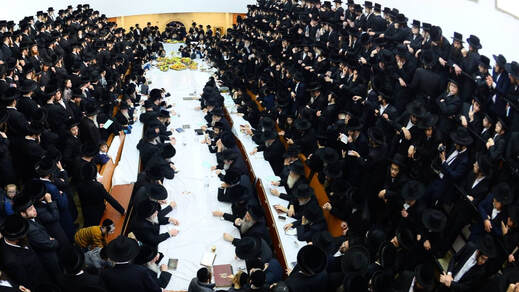
The Chasidim watching the rebbe as he eats, not allowing him to enjoy his food and gorge a bit.
A Tish is a table, a Rebbe's table. I'm not a rebbe. Though, I am a rabbi, and I can tell you that pupils can be very annoying. They follow you everywhere. Ask you questions at the weirdest times. There's a cost to being the spiritual leader. I was once asked a question about my pupil's garden in the middle of a funeral service. No boundaries. I told them tomatoes are a nice addition, and I continued with Bernie's eulogy.
I wanted to see how Chasidim followed their rebbe. So, I joined a Friday night Tish. It was an experience, and I respect the rebbe for putting up with his pupils. A great rebbe. The Tish Began They were all looking at the rebbe. Staring at him. He was sitting at the table and they were watching him the whole time. They brought out the food, he started eating, and they all kept on staring at him. I was bothered. I felt bad, and I told them, 'Let the Rebbe eat.' It's impossible to be sitting at your table, enjoying your food, with everybody looking at you. Have you ever tried eating with people staring at you? You can't. You chew and you're asking yourself if you chewed wrong. A bit of privacy and you can enjoy the Kishka. Here, they're looking at him the whole time. Attentively looking at him. He spills and he knows that's what they're going to be talking about for the next few months. All the Chasidim saying, 'The rebbe's Becher is too big.' The rebbe is stuck eating tiny bites of Challah. He knows the Chasidim will be talking, 'Did you see the huge bite? He must've been very hungry today.' This rebbe couldn't do anything without them watching. Every Move The Rebbe Makes is Important and Analyzed The rebbe, the spiritual leader he is, all of his actions are holy. So, the Chasidim take each move to heart, and analyze it. The rebbe trips, 'Why did he trip?... It must be something you're supposed to do on Shabbis Mevorchim, when we bless the new month. It's tradition. You trip when you're blessing the month of Elul.' Every move is important. The rebbe goes for a dental appointment, it's what the Chasidim are talking about. The dentist is booked for half a year. They're arguing, 'I told you that clean teeth are important. As a community, we have to start flossing more. It's what the rebbe wants.' At the Tish, you could hear them whispering to one another, 'And the rebbe is walking to the table... He is now sitting... And he is washing his hands. The crowd is silent.' I heard some of the Chasidim next to me doing a play-by-play, 'The Rebbe is cutting the Challah... Now. He's pouring the salt.' The other guy was commentating, 'He poured too much salt. He has a bad heart. He has to watch it.' The Bleachers Watching the rebbe really is an event. It's kind of like being at huge sports event. That's why they have bleachers and a play-by-play. They had the big table, with the rebbe at the front, and a bunch of the head Chasidim sitting around the table, and then huge bleachers all around to watch the spectacle. Around a thousand fans watching the rebbe, from the bleachers. The Chasidim love watching it, as each move of the rebbe is holy. Even the rebbe eating. I know this, as I heard, 'And they're now bringing out the fish forks. I believe it's gefilte fish tonight.' The next guy shouted with excitement, 'It is gefilte fish. Holy fish.' The Rebbe's Cup That's an expensive cup. I was wondering where the community monies go to. It goes to the Becher. The Chasidim Take His Food Too They call it Shiraim. This is where the food becomes holy and the Chasidim steal it from the rebbe. The rebbe's taking in some boiled chicken, and they're all reaching for it, 'The rebbe's eating chicken.' Kugel comes out, they're all reaching for it, yelling, 'It's Lokshen Kugel.' He took his first bite, and bam, all the Chasidim are reaching for his food. They're not just staring at his food. They're taking it. One Chasid hurled himself at the table, yelling, 'He touched it. It's holy.' This is why the guy was excited about the rebbe eating gefilte fish. He wanted to grab at the grounded up carp. I'm just happy that the holiness didn't cause a scuffle in the bleachers. My hands didn't move fast enough to get any Kugel. My Tish reaching abilities are undeveloped. The Most Beautiful Songs That's what I noticed it was all about. Holiness and a shared spiritual Shabbat experience. The rebbe is a conductor. He lifted his hand, and they got louder. He banged the table, and the zeal of the Chasidim shined. The dancing was amazing as well. The step forward step back in a non-moving line, with intertwined arms is a beautiful staple of the Tish. It was modern Israeli dancing at its best. It became more lively as the evening went on. When the rebbe started banging, the Chasidim were announcing, 'He wants us to sing with more enthusiasm.' And the singing became even more beautifully intense. Some even started doing the backhanded Shabbat clap, where you clap the back of your hand with your palm, to make it different from a regular clap (which you can hear), due to musical instrument laws on Shabbat. In the end, the dancing line turned into Davening. I think they were praying. They were definitely shuckling. The Rebbe Reacts I heard the rebbe talking, as the Chasidim did. I went near him, as he started banging more. I wanted to know what he was really saying, as the Chasidim became more committed to the songs and prayer dance. He was banging and saying, 'Where is My Tzimis? Who took the Tzimis? And where is the Kugel? It was here a second ago. Was it Yankel? He always takes my food. That was a good Kugel. Who took it?!' His hands went in the air, and I as I approached closer, I heard, 'Where’s my wife? Did they kick her out? We were supposed to eat together.' And then he banged again, 'That is not how you harmonize!!! Get the harmony down!!! You don’t sing like that... And clapping with the back of your hand doesn't work. You don’t clap like this!!!' And the Chasidim were still all singing. With one more hit of the table, the Chasidim sang with more fervor, and the rebbe yelled out, 'Where are the napkins?! You've all taken my food with your hands, and there are no napkins.' At which point, the sponge cake came out and the rebbe didn't even get a chance to touch it, before the Chasidim took it. It was Yankel who stole it. To sum it up, it was a beautiful Erev Shabbat. The respect the Chasidim have for their rebbe is admirable. My congregation wants me fired. I believe the rebbe appreciates that his pupils don't want him to have any downtime. They look up to his every action. The rebbe loves his Chasidim. I just believe that at this Tish, he wanted some of his food for himself. It's just sometimes hard for the rebbe to get a decent meal, without being bothered. I am just happy my congregants are a bunch of heretics. Next week, we shall focus on how the Chasidim follow the rebbe, and don't let him rebbe sleep. Tags:
The Recommended Content Widget will appear here on the published site.
The Chofetz Chaim (Rav Yisrael Meir Kagan) was taking a train back to Radin. I believe it was Radin, as that's where he lived, and had his Yeshiva. None of his Talmidim (students) would drive him. Respecting your rabbi has limits. The roads in Poland aren't paved very well. They asked who would escort their rabbi, around the Yeshiva, and nobody showed up to Shiur that day.
This Jewish guy was sitting next to him on the train. Jews like to sit next to Jews on long trips. It gives a decent amount of time to figure out if they know the same people you know. This guy visiting Radin jumps right to the Chofetz Chaim. Everybody in Radin knows the Chofetz Chaim. Every Jew religious Jew in the world knows the Chofetz Chaim. If you're going to call that Jewish geography, that's pathetic. He starts talking to the Chofetz Chaim, not knowing it is he, the Chofetz Chaim. You can't get any privacy on the train. The Jews will find you. The Chofetz Chaim is trying to get some rest, and now he's got to listen to this guy's thoughts on the deli in Lvov. The Chofetz Chaim is thinking, 'Even when they don't know I'm the Chofetz Chaim, they still ask me questions. I can't get away from this. I could be a tailor and they would bother me.' The guy on the train starts saying how he's going to meet the great Tzadik of Radin, the Chofetz Chaim. If he would've read Shmirat HaLashon, the Chofetz Chaim's book on not speaking Lashon Hara (bad about people), he would know that was Avak Lashon Hara. So, he's going to meet the Chofetz Chaim, without learning his work. You go to meet Stephen King, you read The Shining. The Chofetz Chaim responded, 'Why are going there? He's not that great. He's just a simple Jew.' And the Jewish guy got angry, started the cursing the Chofetz Chaim and hit him. He then came to visit the Chofetz Chaim in his house, and he was embarrassed. The Chofetz Chaim is sitting there with a shiner. He's now asking himself, 'How shall I ask the Chofetz Chaim for blessings and advice about having kids? I clocked him pretty good.' He didn't know what to do. He continued asking himself, 'How did I not realize it's you, the Chofetz Chaim... Now that I see his right side, it's him.' The man asked for forgiveness, and the Chofetz Chaim said that he needn't ask for forgiveness. The Chofetz Chaim was thankful he got hit. He had written an entire book about not speaking Lashon Hara, and he missed the law of not speaking Lashon Hara about oneself. And the guy offered to hit the Chofetz Chaim again. And the Chofetz Chaim learned you can't talk to anybody. You can't say anything to people without offending them, even if it's about yourself. From then on, he was afraid to crack jokes. This was before the Will Smith incident. From then on, The Chofetz Chaim then had to say he was great. But he didn't. As he knows that that's Avak Lashon Hara about yourself. Lessons of What Followed The Chofetz Chaim's students realized it was time for a picture of the Chofetz Chaim to get out. So, they had him pose with a big Kippah. If they had put out a decent photo of the Chofetz Chaim, this whole incident could've been avoided. All simple Jews were offended. Till now, they thought it was an honor to be a Jew. As they learned from the story, being a Jew is not a very important thing. The Chofetz Chaim should've smacked him for speaking Avak Lashon Hara. The real lesson is to never speak about yourself in third person. What's amazing is that when the Rebbe of Lublin said he wasn't that great, he was praised. The Chofetz Chaim gets pummeled. It goes to show how times change. Thanks to this guy, now the Chofetz Chaim had to write another book. We don't know where the Chofetz Chaim was traveling from. It was definitely a violent area. After leaving town, the guy spread word about how the Chofetz Chaim can take a hit. Word spread and the Chofetz Chaim got a reputation, and nobody messed with him anymore. The Lubavitcher Rebbe also said one shouldn't speak Lashon Hara about themselves, but he didn't have to take a hit for it. The Chofetz Chaim left the guy's name out of the story, as that would be Lashon Hara. And thus, we have many beautiful Jewish stories that are never told. When it comes to Tziporah and Moshe, they talk about them. But that's it. And I believe there's a leniency somewhere to talk Lashon Hara about your rabbi, as that's a tradition in all Jewish communities. Please note that we feel bad telling this story, as it might be Lashon Hara. ***See Alei Tamar on the Yerushalmi. If I got the story wrong, you should blame Rav Yisachar Tamar Alav HaShalom. Tags:
The Recommended Content Widget will appear here on the published site.
The Rebbe of Lublin was a great man. That's how he got the name 'The Rebbe of Lublin.' When they know you as your city. When you can claim the whole city. That is when you're great. He was also known as the Seer of Lublin. It depends on what crowd we're talking about. His students knew him as the Rebbe, and those who needed advice on the stock market knew him as the Seer.
When you're the name of your city, you've made it. And then to proceed your name with 'The,' that's the tops. Yaakov Yitzchak HaLevi Horowitz doesn't sound like the Rebbe of Lublin. People might've remembered he was a Levite, but that's about it. If they called him The Rav Yaakov Yitzchak, there is room for argument. Your goal as a rabbi should be to have the city in your name. If you're from Poughkeepsie, you want to be known as the Poughkeepsie Rebbe. You don't want to be known as Frank. You don't want to be Rabbi Frank. If you're known as Rabbi Frank by the end of your career, you've done very little. Everybody knows it. If you did something, you would be the Rebbe of Poughkeepsie. If you're a big rebbe, you either have the name of a town or an acronym. For topper, you add in 'The.' The Rebbe of Lublin made it. He knew it. He had thousands of chasidim. Having a name of a town as part of your name can get to you. It can really work up the ego. Yet, the rebbe was humble. The Story Upon seeing the Rebbe of Lublin with so many followers, another rabbi asked him, 'Why do you allow for this? So many chasidim claiming you a their rebbe, when you admit you're not worthy of this honor.' Choosing a leader can be very hard. Should we give the honor of leadership to somebody who says they're the best? I don't know. Maybe we should have rabbis strutting up to the lectern for their sermons, turning to everybody, 'That's right. I'm your rabbi. I'm here. I'm the best. Show me the love. Shout out to my chasidim. I'm the man. Who's the man? Your rabbi.' I don't remember the rabbi who suggested the Rebbe lose his followers. It may have been Rav Binyamin, Rav Menachem, Rav Berman. All I know is there was no city in his name. Nonetheless, the Rebbe of Lublin listened to him. The Rebbe of Lublin was in agreement, 'What should I do?' The rabbi replied, 'Go up to give a sermon and announce you don't deserve to be their rebbe.' So, the Rebbe got up and told everybody he's not worthy. He said he was just an ordinary Jew and no reason for him to be the one to bless people. And murmurs of more piety and humility came. Everybody was amazed at how big of a Tzadik he was, for saying he wasn't a Tzadik. Roars of adoration throughout the community were abundant, 'Only a Tzadik can do that. What piety!' 'Only a Tzadik would say he's not a Tzadik.' 'It takes a righteous person to let everybody know they're not righteous.' The Rebbe of Lublin did not know what to do. He was trying to get out of people coming to him constantly to get Brachas. He was sick of every single person coming to him with every question. Why did he have to answer questions about real estate? He was annoyed. He wanted to drop the whole Seer of Lublin thing. His reputation was cutting into his relaxation time. He couldn't go to the bathhouse without people asking him for Shidduch ideas and if their silverware was good enough for meat. Pinchas, a local townsman, learning from the lesson of the Rebbe of Lublin, said he wasn't a Tzadik. And all of the people of Lublin reprimanded Pinchas, 'We know you're not. Why such an idiot would say he's not a Tzadik is beyond us.' The other rabbi saw the response of the Rebbe's followers and was shocked by the unexpected result of more adoration. So, he told the Rebbe of Lublin to say he's a Tzadik. The Rebbe told him, 'I can't do that. I cannot lie. When you told me to tell them I am not a Tzadik, I did it. When you wanted me to claim that I was not deserving of this honor, as I am a simple Jew, I agreed. However. Now you want me to lie and say I'm a Tzadik. I cannot do that.' And the rabbi was stuck. And the Rebbe of Lublin realized the rabbi was yet another person in the town asking him to do something. As the rebbe with the name of a town, everybody comes to you with questions. Lessons of What Followed The Rebbe of Lublin was later found to be not happy with his chasidim, knowing that they didn't trust him. The rabbi who was giving the Rebbe of Lublin this advice was an extremely humble rav. He was so humble, his chasidim consisted of two. When he saw the response of the Rebbe of Lublin, he decided to tell his pupils that he was a great Tzadik. And his chasidim left him. His pupils ran away saying, 'We thought our rabbi was full of humility, when he said he was humble.' The rabbi ran after them saying that he was joking. It turns out that his chasidim didn't get sarcasm, like those of the Rebbe of Lublin. This whole episode turned out to be a great lesson to the rebbe’s followers. When you're a showoff, people hate you. When you're humble, you can be great. People respect you, call you the best. If you want everybody to think you're amazing, be humble. And all of the chasidim became very humble. And they got into many fights over who is humbler. Yankel proclaimed, 'I am the humblest.' And they knew they were Tzadiks. There is no feeling like going home being able to look in the mirror, knowing you're righteous and saying to yourself 'I'm humble.' Learning from the Rebbe of Lubin, rabbis around the world started saying 'I am a nothing.' I heard a story of a rabbi who went up to the ark on Yom Kippur. He goes up kisses the curtain and cries out, 'God. I am a nothing.' The Chazin, cantor, upon seeing this, goes up to the ark and wails, 'Before you God, I am nothing. I am nothing in this world.' Then the Gabai, sexton, goes to the ark and cries out, 'Before you God. I am nothing. I am a total nothing. A nothing.' The Chazin, turns to the rabbi upon seeing this, and pointing to the Gabai he mocks, 'Look who thinks he's a nothing.' When the Rebbe of Lublin saw the other rabbi talent out there, he decided that it wasn't a bad idea that the chasidim were following him. As the Seer of Lublin, the Rebbe knew that if he said he wasn't great, he would score huge points with his chasidim. It was an amazing move. He came out on top, and scored more chasidim. The Chafetz Chaim took this lesson to heart, and when a guy said the Chafetz Chaim was a great man, the Chafetz Chaim said he isn’t. And the Chafetz Chaim got smacked. ***See Lilmod uLilamed, the section on VaYishlach. If I got the story wrong, it's their fault. Tags:
The Recommended Content Widget will appear here on the published site.

What it looks like when the rebbe doesn't show to shul during the Ten Days of Repentance, and the Chazin is going very slow. (Photo: Maurycy Gottlieb - From Jewish Art, edited by Grace Cohen Grossman)
The Skeptical Litvak – They All Are
The rebbe didn't show up for Selichot prayers during the Ten Days of Repentance. The people of Nemirov asked, ‘Where is the Rebbe?’ And all the disciples now had to repent for speaking Lashon Hara. Speaking gossip is a sin. You shouldn’t ask such questions. It leads to gossip. But they did, as it was about the rebbe, and everybody talks about rabbis. People love to talk about rabbis. You see the rabbi at the restaurant and everybody’s talking about how he didn’t have enough intent with his blessing, and too little stuffed derma. Discussion continued and the Chasidim knew there is only one place their rebbe could be. In heaven. A Litvak came to the town during this time of Selichot, early in the morning, and he noticed the rebbe's absence. The pupils of the Rebbe of Nemirov said, ‘Where is our Rebbe? He is in heaven.’ And the Litvak laughed. It was more of a guffaw. We all know Litvaks are very sarcastic. They’re straight and they have no creativity with their practice of Mitzvot. When was the last time a Litvak celebrated Shabbat by starting a bonfire, playing an electric guitar, throwing together some fireworks, and tanning a hide? No creativity. Upon hearing that their rebbe was in heaven, the Litvak knew the rebbe was up to something. To quote the Litvak, ‘I have seen many people try to get out of Minyin. People love to skip Selichot. I’ve heard people were sick, with a cough. I’ve heard people had to go to work. They didn’t even have a job. I’ve even heard people say they had to watch their kids, when we had babysitting at the shul. But using heaven as an excuse to get out of services?!’ The Litvak laughed and reprimanded, ‘You fools. Your rebbe is not in heaven. Even Moshe, our great leader, didn't go up to heaven. It’s impossible.’ And the Litvak said, ‘I will find out.’ And he did. Sleeping Under Somebody’s Bed is Not Comfortable – Even if They Are a Rebbe That evening, the Litvak snuck into the rebbe's house and slept under his bed. The Litvak was scared. Of course, he was scared. It was even creepy back then to sleep under somebody's bed. But the Litvak did it. I don’t suggest sleeping under anybody’s bed. There is no precedent to sleep under somebody’s bed, unless if you are their student. Then it makes sense. You learn their snoring patterns, and you can be a better disciple. He wanted to see what the rebbe was up to. He had to get to the bottom of this skipping prayers racket the rebbe was running. And the Litvak was going to figure it out, by trespassing and hiding under the rebbe’s bed, and taking some of the rice cakes he found in the kitchen. It wasn’t easy. He couldn’t breathe normally or the rebbe would figure him out. He also couldn’t breathe normally, because of the dust under the rebbe’s bed. The rebbe wasn’t known for sweeping. They didn’t have Swiffers back then. It was a hard night and the Litvak didn’t get much sleep. The rebbe even took a fly swatter and smacked him with it a few times, thinking his room was infested with loud bedbugs. What Rebbes Do When They Skip Prayers and Selichot The next morning, when all had left the house, the rebbe got up. ‘Ah Ha. The rebbe wakes up late. Everybody else was out of the house at 5:30am and the rebbe is only moving at 5:35am. A sloth,’ thought the Litvak, ‘I got him.’ Then, the rebbe put on peasant clothes, and took an ax and rope with him. The rebbe went to the forest and cut down a tree, then cut it into pieces and tied it in the rope. He was the only in shape rabbi I’ve ever heard of. I’ve never heard of a rabbi who does anything but go to the shvitz. Rabbis sit and sweat. They don’t exercise. Not the Rebbe of Nemirov. He exercises. Two hundred pushups every morning. The Litvak was lucky he skipped them that day. Legend has it that no other rabbi could take the Rabbi of Nemirov in an arm wrestle. But that's a different story of inspiration. He competed in strong man competitions and lumberjack carries under the name Vlad. The rebbe started dragging the wood. The Litvak was still there, following the rebbe. He was very good at stalking. He had done it before. If I recall correctly, there was another time the Litvak slept under a rabbi’s bed because he was interested in finding out what he wears under his Bekishe. What’s under the rebbe’s coat has always been an anomaly, The Litvak was disturbed. Why did the rebbe need to start a wood business? Why are his disciples not paying him enough? Why do the rebbe’s students not sleep under his bed? Are they just not good pupils? Why is the rebbe killing the forest? There were many questions. The rebbe dragged the wood to a poor women's house who was sick, and he knocked on the door. You don’t just enter a house, unannounced. She probably would’ve shot the rebbe. This story is based on the Chasid's account. That student of the rebbe was following the Litvak. I can’t tell you what kind of house it was. You have to ask the Litvak. I believe it was wood. Might have been brick. Not a sturdy foundation. A very nice kitchen. Granite countertops. Granite was big in the 1800s. The poor woman asked, ‘Who’s at my door.’ The Rebbe said, ‘Vassil.’ Vassil is not a Jewish name. Nobody names their kid Vassil. It hurts their chances at a good Shidduch. She told the rebbe he can come in. The rebbe’s sale, posing as Vassil, was, ‘You don’t have money? You can repay me later. You believe in Gd, but you don’t believe that He will give you six kopeks?’ The rebbe wasn’t a very good businessman. He could’ve got more than six kopeks out of her. He could’ve told her that she didn’t have to pay him a thousand kopeks. But he didn’t. He missed the moment to make a bit. The Litvak however, learned a valuable lesson. The Litvak became very rich later in life, when he sold a house for eight million kopeks, by telling the guy that if he believes in Gd he should buy it. The guy purchasing the house only had a million kopeks. With newfound belief in Gd, due to the Litvak’s sales technique, the guy borrowed the rest from the bank. The guy lost the house when he couldn’t make the first payment. Thank Gd, the Litvak got top dollar on the deal, What Happens in A Poor Women's House The rebbe entered the poor women’s house. As the rebbe put the wood in the oven, he recited the first portion of Selichot in a groan. That’s the tradition. I know they do that at my shul. It’s early in the morning and you’re supposed to express how tired you are when repenting. If you show Gd how hard it is, and complain, He’s more merciful. When the wood began to burn and it became bright, he recited the second portion of Selichot with more joy. When the fire was lit and ready, he recited the third portion and shut the oven. Why the rebbe shut the stove, we don’t know. We hope the stove still made the room warm, even though he shut it. The Litvak was amazed that the rebbe knew the Selichot by heart. And who could recite the Selichot so fast?! The rebbe himself had been skipping the prayers all this time. The Litvak became a Chasid of the Rabbi of Nemirov. And every year, when they spoke of the rebbe ascending to heaven during the Days of Awe, the Litvak wouldn’t laugh anymore. The Litvak would say, 'If not higher.' And then he would tell everybody how the rebbe Davens too fast and had to work on his Kavanah. Lessons of What Followed The Litvak learned the lesson from the rebbe and stopped going to shul. He started working as a laborer and never helped with Minyin again. The community wanted him to help with the quorum, but he said he can get closer to Gd by not showing up. Years later, the Chasidim of the rebbe learned of his great Mitzvah. Once the story got out, they couldn't get a Minyin in Nemirov for Selichot anymore. Many don’t know the truth behind the story. It was the rebbe’s morning workout. He had to get it out of the way, and he knew the Litvak was following him. He couldn’t just chop down a tree and leave it. The Litvak would know the rebbe was just trying to get jacked. Why the rebbe didn't use his strongman name, 'Vlad,' we will never know. The rebbe groaned when putting in the wood, for he killed his back carrying the bundles all the way to the sick woman’s house. The Litvak couldn't get a hint. The least the Litvak could’ve done is offer to help. If you’re stalking somebody already, you might as well help. The rebbe was singing the Selichot more joyously once the oven was lit, as he wasn’t freezing anymore. The house was very cold. Being the proper guest the rebbe is, when he’s in the character of Vassil, he didn’t want to complain to the woman. The poor woman tried finding Vassil to pay him the six kopeks. She wanted to pay him back so badly. Trying to pay back Vassil, she got caught in the cold and came down with pneumonia. If she would’ve known it was the rebbe, she would’ve been a healthier woman. She would’ve went to his house and even given a donation to the Yeshiva. The Litvak couldn’t mock the rebbe anymore and he lost his sense of humor. ***For the story, also see I.L. Peretz’s Selected Stories Tags:
The Recommended Content Widget will appear here on the published site.
The Rebbe of Lublin was a great Rebbe, and he lived in Lublin. He did not live in Lvov. He lived in Lublin. They were thinking of calling him the Rebbe of Lvov, but he didn't live there, and he didn't even like visiting Lvov.
Every morning, he would sit at the head of his table and pray, 'H' I'm praying for my breakfast.' And at that moment, his servant would come out and bring him his breakfast. At that point, the Rebbe would say, 'H' thank you for my breakfast.' And the servant was bothered, as he knew he wasn't Gd. He had some friends that were pretentious and gaudy, who thought they were great, but he knew he wasn't Gd. He was bringing the rebbe his breakfast, not Gd. The next day, as always, the Rebbe did the same, coming home, sitting in his seat and singing to Gd, 'H' I'm praying for my breakfast.' The servant then brought out the breakfast, and the Rebbe said, 'H' thank you for my breakfast.' And the servant went back to the kitchen, angry, wanting to yell, 'When will he learn my name?!! I've been working for him for years. I am not Gd. Does he not know where his breakfast comes from?' To note, saying 'servant' is OK. This is the 1800s. Being a servant was a good job. The next day, the same thing happened, and the servant was angered that the Rebbe shows appreciation to Gd and not to him. The servant then came up with a scheme. He decided that he won't bring him breakfast the next morning. A better scheme would've been to bring the Rebbe bull's-eye eggs. The Rebbe liked them scrambled. Bull's-eye would've thrown the Rebbe for a loop. That next morning, the Rebbe started praying, 'H' I'm praying for my breakfast.' The servant came out with an empty tray. That was funny in an ironic way back then. The field of comedy wasn't fully developed yet. It was pre-vaudeville. At that exact moment, there was a knock at the door, and a man stood there thanking the Rebbe, as his wife is OK. He stood there with food, and asked the Rebbe to take it, as a gesture of their appreciation. And the Rebbe ate it and said, 'H' thank you for my breakfast.' How the eggs were still warm is a miracle that nobody can explain to this day. And from that moment on, the servant knew he would never get thanked. Lessons of What Followed He understood from the incident that he would never be appreciated, as all comes from Gd. To feel fulfilled, he started looking to alcohol. Yet. He showed up to work every day, on time, and always made breakfast, lest he lose his job to another thankful congregant. It turns out the servant didn't get the raise he was hoping for. It was impossible for him to find the right time to ask for a raise. Gd got in the way of that too. What bothered the servant even more was that the Rebbe couldn't even thank the guy at the door. It appears he forgot that guy's name too. Check out the song on Journeys II Tags:
The Recommended Content Widget will appear here on the published site.
|

They had a Jewish diamond store. They said they were looking for a customer base that was made of American Jewelry. You get it? Jewelry. Jewry. American Jewelry. If you were thinking American Jewry, that's anti-Semitic. Or pro-jewelry. This pun keeps on giving. 
A well put together cover page for a Jewish newspaper. I knew I was reading a Frum Jewish newspaper, as they found a way to fit 28 ads on the cover page. And the feature article is an ad for Amor jewelry... A properly written Jewish magazine should be advertisements. I once read a non-religious magazine, and I felt like a sinner when I read an article to only find there was no phone number at the end of it. I felt defiled… It’s a shame the Amor ad is so big. They could’ve got another 20 ads in.

Click on the picture for tickets and to see upcoming events in Rochester, NY

(Shulchan Aurch 568:1) One who eats by accident on a fast must continue fasting. Making for a three hour fast to fully mourn the Churban of the Temples. I believe that break between meals fully calls to heart the true yearning of my soul over the loss of the Batei Mikdash... You can't eat once you remember you sinned, as one who committed a sin can't commit a second by snacking once they're already full.
Categories
All
Archives
July 2024
|

Your Weekly Jewish Humor Magazine for a Gazunta Laugh about Life
We found
results for you
We've got nothin'!
 RSS Feed

© 2021 Kibbitzer Magazine and JHF. All rights reserved.
The Kibbitzer, where we take Jewish comedy seriously!!! If you are offended, it's satire.
A friend of the Off The Wall Comedy Theater, JHF and The Kibbitzer are here to bring unity and Jewish connection for you, in honor of Rabbi Kilimnick ZT"L.
The Kibbitzer is Funded by the JHF (The Jewish Humor Foundation) and you.
Contact us to make a donation and to sponsor Harbatzas Tzchok, the spreading of tradition through laughter, with articles or series in honor and memory of your loved ones.
The Kibbitzer, where we take Jewish comedy seriously!!! If you are offended, it's satire.
A friend of the Off The Wall Comedy Theater, JHF and The Kibbitzer are here to bring unity and Jewish connection for you, in honor of Rabbi Kilimnick ZT"L.
The Kibbitzer is Funded by the JHF (The Jewish Humor Foundation) and you.
Contact us to make a donation and to sponsor Harbatzas Tzchok, the spreading of tradition through laughter, with articles or series in honor and memory of your loved ones.
6/28/2023
0 Comments